
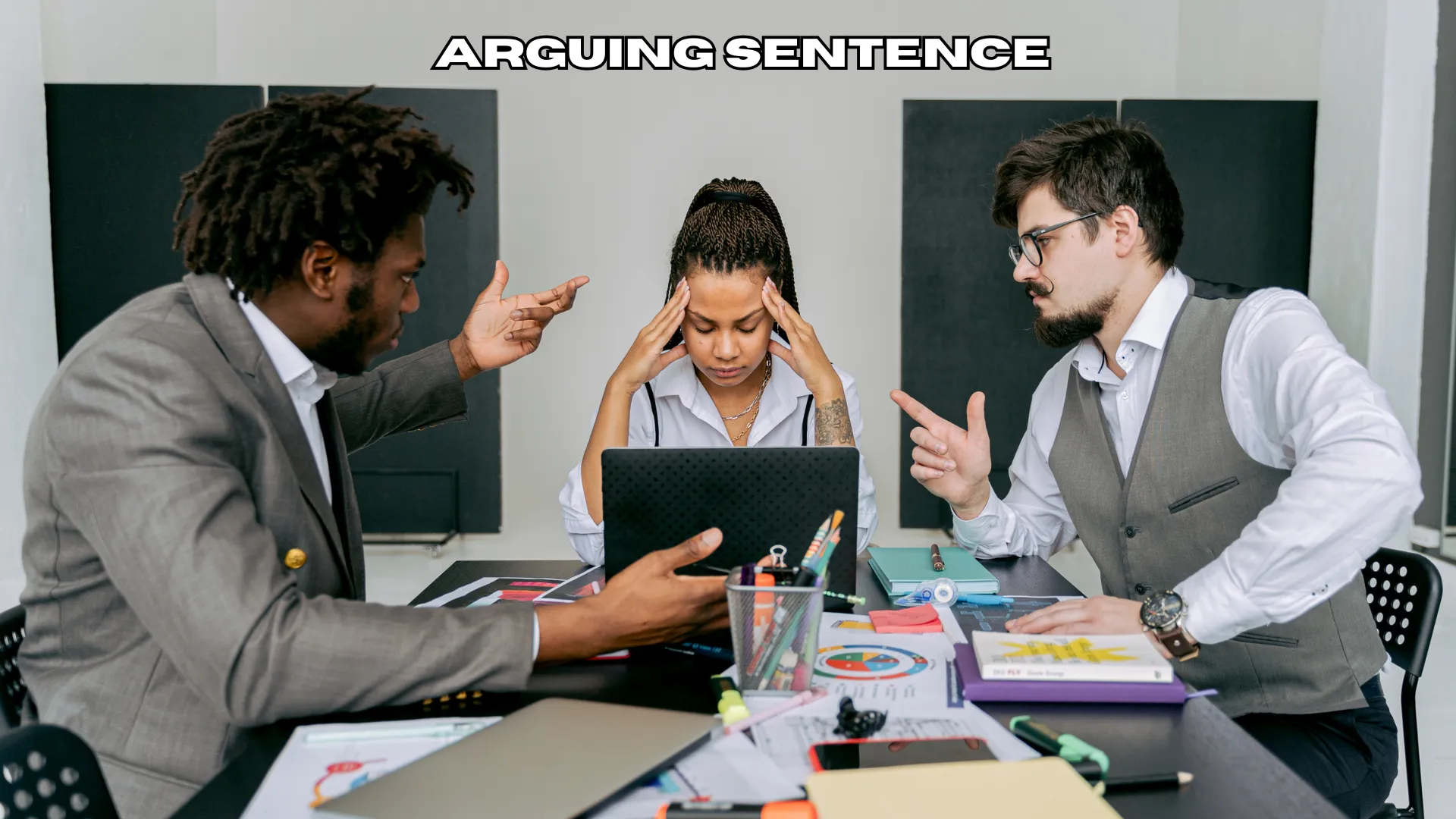

An effective argument is not simply about disagreeing with someone. It involves presenting ideas clearly, supporting claims with evidence, responding to opposing viewpoints, and communicating persuasively. Whether in academic writing, professional discussions, debates, legal settings, or everyday conversations, constructing a strong arguing sentence requires careful word choice and logical structure.
Many people assume that arguing means becoming confrontational or emotional. In reality, successful arguments rely on clarity, reasoning, and strategic communication. A well-crafted arguing sentence can influence opinions, strengthen discussions, and demonstrate critical thinking skills.
At the same time, many online resources focus only on simple sentence examples while ignoring the practical realities of persuasive communication. Factors such as audience psychology, tone, context, vocabulary selection, and credibility significantly influence whether an argument succeeds or fails.
This article examines how arguing sentences work, when to use them, common mistakes to avoid, and the big words to use when arguing that can strengthen your communication.
What Is an Arguing Sentence?
An arguing sentence is a statement designed to present, defend, challenge, or support a particular viewpoint. These sentences are commonly used in:
- Academic essays
- Debates
- Courtrooms
- Business meetings
- Negotiations
- Opinion articles
- Professional communication
- Everyday discussions
Unlike descriptive sentences, arguing sentences attempt to persuade, justify, challenge, or critically analyze an idea.
For instance:
Weak statement:
Social media affects people.
Strong arguing sentence:
Social media platforms significantly influence public opinion by shaping information exposure and reinforcing existing beliefs.
The second sentence presents a clear position that can be supported with evidence and reasoning.
Why Arguing Sentences Matter in Communication
Strong arguments influence decision-making in nearly every aspect of life.
Professionals use arguing sentences to:
- Present business proposals
- Negotiate contracts
- Advocate policies
- Resolve conflicts
- Defend strategic decisions
- Influence stakeholders
Students use them to:
- Write essays
- Participate in debates
- Analyze literature
- Present research findings
In everyday life, arguing sentences help individuals communicate opinions effectively without relying solely on emotions.
Characteristics of a Strong Arguing Sentence
An effective arguing sentence typically includes several elements.
Clarity
The reader should immediately understand your position.
Specificity
Vague arguments weaken persuasion.
Evidence Potential
A good argument can be supported with facts, examples, or reasoning.
Logical Structure
Arguments should follow a coherent thought process.
Appropriate Tone
Professional and academic arguments require different language than casual conversations.
Basic Arguing Sentence Examples
Here are several examples of effective arguing sentences:
- Governments should invest more heavily in renewable energy to reduce long-term environmental risks.
- Remote work policies can improve employee productivity when implemented strategically.
- Artificial intelligence will significantly change workforce requirements over the next decade.
- Public transportation investments contribute to economic development and urban sustainability.
- Educational systems should prioritize critical thinking skills alongside traditional academic subjects.
Each sentence establishes a clear position while allowing room for supporting evidence.
Academic Arguing Sentence Examples
Academic writing requires structured and evidence-based arguments.
Examples include:
- The evidence suggests that socioeconomic factors significantly influence educational outcomes.
- Recent research indicates that climate adaptation strategies require localized implementation approaches.
- Historical analysis demonstrates that technological advancement often produces unintended social consequences.
- The available data supports the conclusion that healthcare accessibility directly affects population outcomes.
- Existing literature reveals substantial gaps in current policy frameworks.
These sentences establish authority while maintaining an objective tone.
Professional Arguing Sentence Examples
In professional settings, arguing sentences often focus on strategy, performance, and decision-making.
Examples:
- Current market conditions justify revising our pricing strategy.
- Customer feedback data indicates a need for operational improvements.
- The proposed investment carries significant long-term growth potential.
- Our analysis suggests that delaying implementation may increase overall project costs.
- Alternative approaches should be considered before finalizing this decision.
Professional arguments emphasize evidence and business outcomes rather than personal opinion.
Big Words to Use When Arguing
Many individuals search for big words to use when arguing because sophisticated vocabulary can strengthen communication when used appropriately.
Substantiate
Meaning: To provide evidence supporting a claim.
Sentence:
The available research substantiates our position regarding policy reform.
Refute
Meaning: To prove an argument incorrect.
Sentence:
Recent evidence effectively refutes the earlier assumptions.
Corroborate
Meaning: To confirm or support with additional evidence.
Sentence:
Multiple studies corroborate these findings.
Contend
Meaning: To argue or assert.
Sentence:
Many economists contend that inflation remains a significant concern.
Assert
Meaning: To state confidently.
Sentence:
The report asserts that operational changes are necessary.
Rebuttal
Meaning: A counterargument.
Sentence:
The opposing argument fails to address our primary rebuttal.
Plausible
Meaning: Reasonable or believable.
Sentence:
Their explanation appears plausible but lacks supporting evidence.
Ambiguous
Meaning: Open to multiple interpretations.
Sentence:
The proposed policy language remains ambiguous.
Discrepancy
Meaning: An inconsistency.
Sentence:
A significant discrepancy exists between the reported figures.
Conclusive
Meaning: Final or decisive.
Sentence:
The available evidence remains inconclusive rather than conclusive.
Why Using Big Words Incorrectly Weakens Arguments
One of the most overlooked realities of persuasive communication is that advanced vocabulary can actually weaken arguments when used improperly.
Common mistakes include:
Overcomplicating Simple Ideas
Complex language can obscure the actual argument.
Using Vocabulary Incorrectly
Misusing sophisticated words damages credibility.
Prioritizing Appearance Over Logic
Strong reasoning remains more persuasive than difficult vocabulary.
Ignoring the Audience
Professional, academic, and casual audiences require different communication styles.
Experienced lawyers, negotiators, and academics often prefer clarity over unnecessary complexity.
Arguing Sentences for Debates
Debate arguments require direct and persuasive language.
Examples:
- The evidence overwhelmingly supports this conclusion.
- The opposing argument fails to address the central issue.
- This position ignores several critical variables.
- The proposed solution creates more problems than it solves.
- Historical evidence suggests a different interpretation.
These structures help speakers maintain logical consistency.
Arguing Sentences for Essays
Essay writing requires balanced and evidence-based arguments.
Examples:
- This analysis demonstrates the importance of policy intervention.
- The findings indicate a strong correlation between these variables.
- Several factors contribute to this outcome.
- Existing evidence supports this interpretation.
- Alternative perspectives deserve further consideration.
These sentences establish academic credibility.
Hidden Challenges of Effective Argumentation
Many resources fail to discuss the practical challenges of constructing persuasive arguments.
Emotional Bias
People often prioritize emotions over evidence.
Confirmation Bias
Individuals tend to accept information supporting existing beliefs.
Cognitive Overload
Too much information can reduce persuasion effectiveness.
Audience Resistance
Strong evidence may fail when audiences perceive threats to identity or values.
Understanding these psychological barriers improves argumentative effectiveness.
How Lawyers, Negotiators, and Professionals Build Arguments
Professionals rarely begin arguments by presenting conclusions.
Instead, they typically:
- Establish common ground.
- Present evidence gradually.
- Anticipate objections.
- Address counterarguments.
- Reinforce credibility.
- Guide audiences toward logical conclusions.
This strategic approach often proves more effective than direct confrontation.
Common Mistakes When Writing Arguing Sentences
Several mistakes frequently weaken arguments:
Making Absolute Claims
Statements using words like always or never often create vulnerabilities.
Using Emotional Language Excessively
Strong emotions can reduce perceived credibility.
Ignoring Counterarguments
Acknowledging opposing viewpoints strengthens persuasive writing.
Providing Insufficient Evidence
Unsupported claims rarely persuade informed audiences.
Confusing Opinion With Fact
Distinguishing between evidence and personal belief remains essential.
How Artificial Intelligence Is Changing Argumentative Writing
An emerging area rarely discussed involves the influence of artificial intelligence on persuasive communication.
AI tools increasingly assist with:
- Argument generation
- Counterargument analysis
- Debate preparation
- Legal research
- Academic writing support
However, human judgment remains essential because effective arguments require understanding context, psychology, ethics, and audience behavior.
Conclusion
A strong arguing sentence combines clarity, logic, evidence, and strategic communication. While advanced vocabulary and persuasive techniques can strengthen arguments, the most effective communicators prioritize substance over complexity.
Whether writing essays, participating in debates, negotiating business decisions, or engaging in everyday discussions, understanding how arguments function can significantly improve communication effectiveness. Equally important is recognizing that successful arguments depend not only on what is said but also on how, when, and to whom it is communicated.
FAQs
An arguing sentence presents a clear position or claim that can be supported with evidence, analysis, and reasoning.
Words such as substantiate, corroborate, refute, contend, assert, plausible, discrepancy, and rebuttal are commonly used.
Use clear positions, logical reasoning, supporting evidence, and appropriate vocabulary while addressing counterarguments.
No. Effective arguments depend more on logic and evidence than on sophisticated vocabulary.
Arguing generally involves presenting and defending a position, while debating follows structured rules and formal procedures.
Psychological factors such as emotional bias, confirmation bias, and audience resistance can reduce persuasive effectiveness.
How do lawyers construct persuasive arguments?
Lawyers typically establish credibility, present evidence strategically, anticipate objections, and address counterarguments systematically.